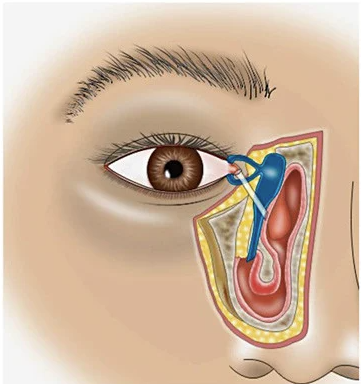
Excessive tearing is a complex and very bothersome symptom for patients. There are many causes to tearing including tear drain problems, eyelid problems or anything that can irritate the eye to cause overproduction of tears. We like to think of tearing like plumbing—the faucet can be turned on too fast, the pathway to the drain can be disrupted or the drain itself can be plugged. The most important first step in addressing a watery eye is to determine what is causing it.
When you come in for a tearing evaluation with Dr. Stewart, you will undergo testing to determine the cause of your tearing. This may include specialized testing for ocular surface conditions like dryness or meibomian gland dysfunction, examination or probing of the opening to the tear drain (puncta), and saline irrigation of the tear duct to assess for blockages further down. These in office procedures are not typically painful but may be uncomfortable for a few seconds. From here, you and Dr. Stewart will discuss the causes of your tearing and determine how to move forward.
A nasolacrimal duct obstruction is a blockage or narrowing of the tear drainage system as it passes from the eyelids into the nose. The blockage may be complete, or it may be partial. In some instances, the wider collection area of the tear duct called the lacrimal sac may become infected. This is called dacryocystitis and is often painful. Patients with dacryocystitis often experience mucus discharge and crusting in addition to tearing.
Causes of a blockage might be narrow anatomy, sinus disease, prior injury, growths or tumors. It is important to have a thorough examination and evaluation of the reasons for a nasolacrimal duct obstruction. Dr. Stewart may use a small handheld camera in the office to examine the opening of the nasolacrimal duct within your nose.
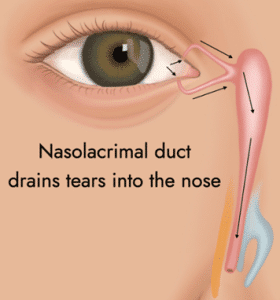
Once a nasolacrimal duct obstruction is confirmed, Dr. Stewart will discuss treatment options with you. Treatment of nasolacrimal duct obstructions is often surgical. The options may include:
- Balloon Dacryoplasty: This procedure involves a probe with a balloon on the end of it that is placed within the nasolacrimal duct, then inflated to stretch out the existing nasolacrimal duct. This may be useful for partial nasolacrimal duct obstructions.
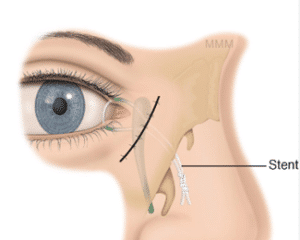
- External Dacryocystorhinostomy (DCR): This procedure re-routes the tear drainage system to a larger and more direct path. This involves a small 1cm incision hidden in the thin skin of the lower eyelid. External DCR has the highest success rate of surgical procedures for nasolacrimal duct obstructions.
- Endoscopic Dacryocystorhinostomy (endo DCR): This procedure also re-routes that tear drainage system to a larger and more direct path but is performed through the nose using endoscopes to avoid an external incision. The success rate is slightly lower than an external DCR but does have a slightly faster healing time without an incision.
Most of the surgeries performed for nasolacrimal duct obstructions require placement of a soft silicone stent at the end of surgery. The goal of the stent is to keep the pathway open as your body heals around the stent. The stents are not tubes that allow tears to flow inside of them, so you may experience some tearing while the stent is in place. Most people are not bothered by the stents.
Tearing may also be caused by closure or shrinking of the openings of the tear drains, called the puncta. This may happen over time, or be caused by infections, inflammation or growths. A complete exam can identify any issues within the puncta or the second portion of the tear drain called the canaliculus. These issues are often treated with minor in office procedures and can resolve quickly with the correct approach.
Sometimes the issue causing tearing is difficulty of the tears making it into the drain. Gravity may cause the tears to spill over the lids instead of into the tear drain depending on your eyelid position. This is caused by malposition of the eyelids, or eyelids that are too loose to properly windshield-wipe the tears over and up to the drain entrances (puncta).
If the eyelid position or tightness is found to contribute to your tearing issues, Dr. Stewart may recommend a surgery to tighten and reposition the eyelids to allow them to function properly.
Some tear drain procedures may be performed endoscopically through the nose, which means that no incision is made on the face. Not everyone is a good candidate for this type of surgery, so it is important to have a thorough exam and discussion with Dr. Stewart prior to considering endoscopic surgery. In the correct patient, endoscopic surgery may be less painful and have a quicker recovery than external surgery.
When there is significant scar tissue of the early portions of the tear drain, or other approaches have failed to cure tearing, a glass tube called a Jones tube may be inserted to bypass your damaged tear drain entirely. This is called an endoscopic CDCR (conjunctivodacryocystorhinostomy) with Jones tube placement. The tube allows tears to pass directly into the nose, supported by gravity and your breathing. Occasionally the tubes need to be cleaned out in clinic after the procedure, and they may need replacement after many years.