Premium lens replacement (PLR), also called refractive lens exchange, replaces your eye’s natural lens with an artificial intraocular lens (IOL). It can correct nearsightedness, farsightedness, astigmatism, and age-related difficulty seeing up close. For adults in their mid-40s and older, premium lens replacement may be an alternative to LASIK that reduces dependence on glasses or contacts. Because the natural lens is removed, you also won’t develop cataracts in that lens later in life.
With offices in Northwest Austin and Westlake, TX, Austin Eye Clinic has performed premium lens replacement since 2000. Shannon M. Wong, MD, is a board-certified ophthalmologist who has performed more than 20,000 cataract and premium lens replacement procedures. Our experienced physicians will evaluate your vision, discuss your options, and help you determine whether this approach is right for your needs.
Benefits of Premium Lens Replacement
As technology has evolved, the optimal surgical vision correction method for individuals in their mid-40’s and older is Premium Lens Replacement (PLR).
For example, with an individual that is 49 years old (or older), if you need glasses to read up-close or see far away, you could have LASIK surgery to correct your vision. LASIK will enable you to see like a normal person your age. So, this 49-year-old individual would:
See far away without glasses BUT require reading glasses to see the computer and closer
Would experience normal age-related vision changes due to the normal development associated with lens changes and cataract formation with each year
Ultimately, cataract surgery would be needed once this individual’s lens develops into a visually significant cataract (usually by age 75)
In contrast, this same 49-year-old (or older) individual above with Premium Lens Replacement would:
See far away without glasses AND see the computer and closer with minimal and often no reliance on reading glasses
Would experience very stable vision (more stable than a normal person with a natural lens between the ages of 49-100) as they age
Never need cataract surgery as they age
Premium Lens Replacement (PLR) technology continues to evolve with the continued improvement in lens implant designs. As of 2023, current lens implants used in PLR create vision similar to that of an individual age 40-42. So, PLR can enable individuals 45-100 years old to see younger than their age permanently.
In our practice, LASIK is the preferred surgery for vision correction younger than 40. PLR is the preferred surgery for vision correction for patients over the age of 45.
HOW DOES PREMIUM LENS REPLACEMENT (PLR) WORK?
PLR involves a 10 to 15 minute procedure that is painless, uses eyedrop anesthesia and which produces improved vision within hours. Most patients will regain normal function in less than one day.
During the procedure we remove and replace the aging lens inside the eye with an advanced lens implant that can correct the nearsightedness / farsightedness / astigmatism and presbyopia. Your aging lens is replaced with a new lens implant that provides outstanding vision and optical quality that will last a lifetime.
Why Choose Austin Eye Clinic for Premium Lens Replacement in Austin?
Choosing premium lens replacement is about more than replacing your natural lens. You want a surgeon who understands how different lens implants can affect your vision in everyday life. Austin Eye Clinic has performed premium lens replacement since 2000, treating more than 10,000 people with the procedure. Board-certified ophthalmologist Shannon M. Wong, MD, has performed more than 20,000 cataract and premium lens replacement surgeries. He also underwent premium lens replacement himself in 2017, giving him firsthand experience.
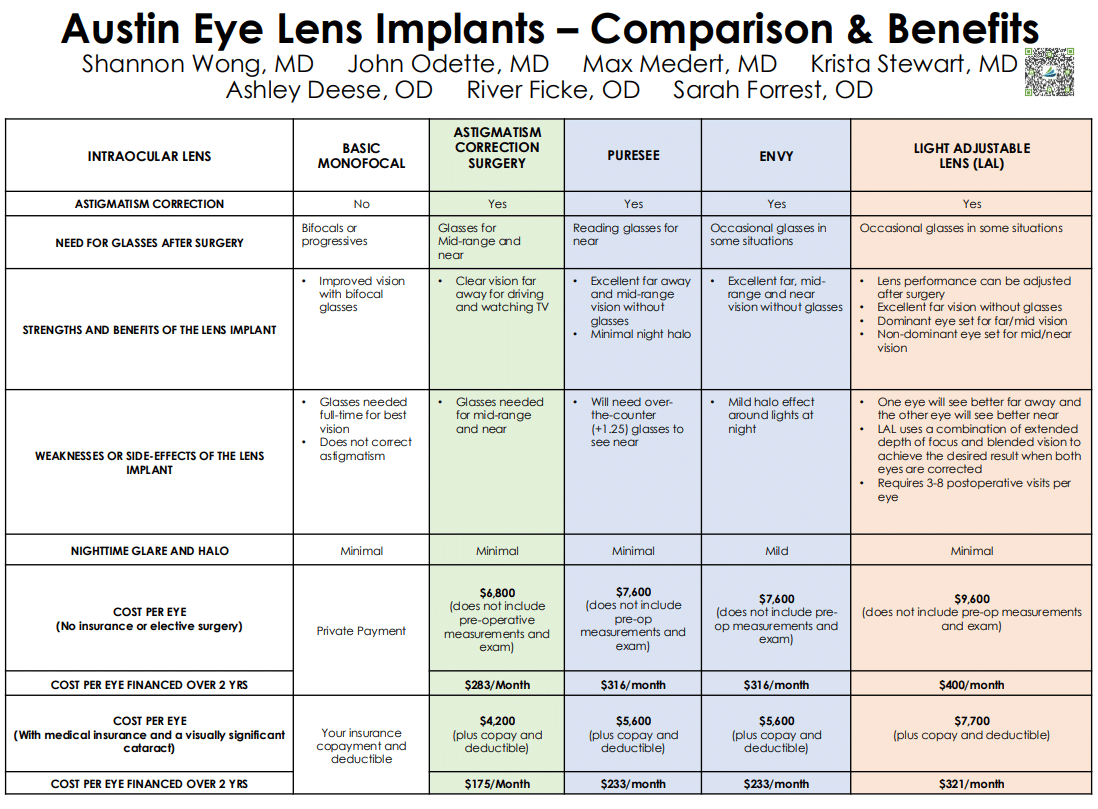
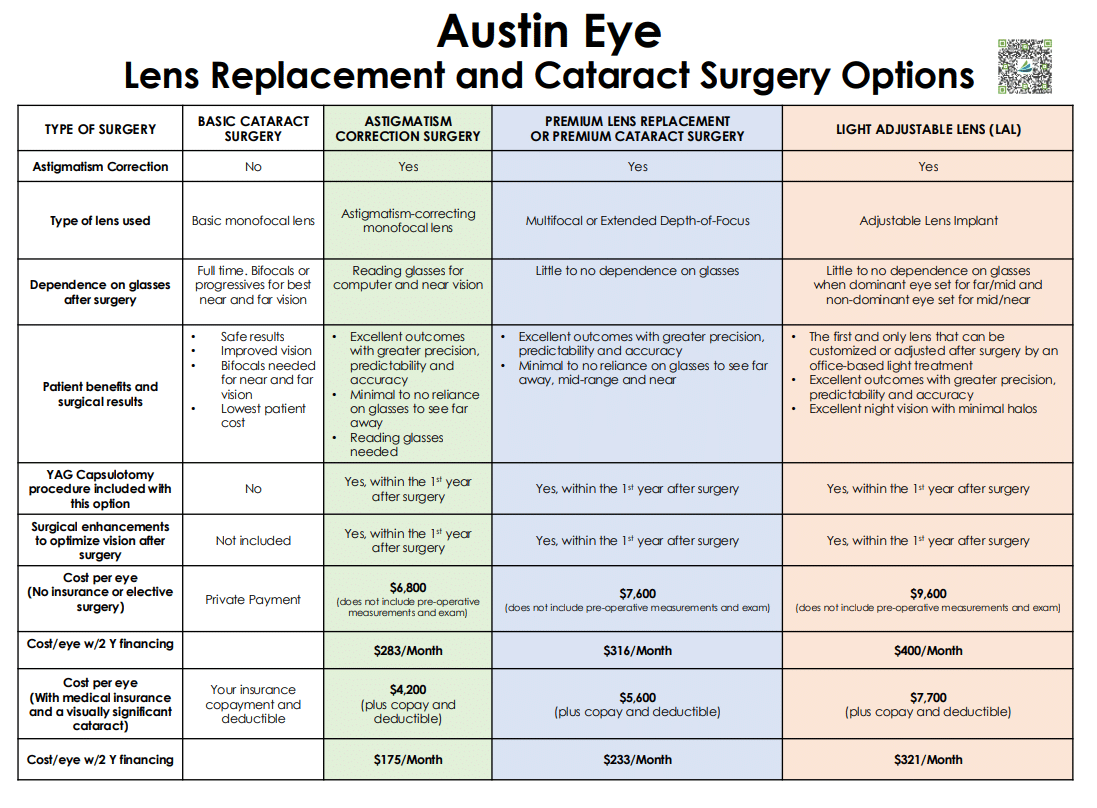
Many of Dr. Wong’s surgeries take place at the Austin Eye Laser and Surgicenter in Westlake. Our team works with advanced intraocular lenses, including multifocal, extended depth of field, astigmatism-correcting, and Light Adjustable Lenses. We’ll consider your eye health, prescription, and daily activities when discussing which lens implants may reduce your reliance on glasses. With offices in Northwest Austin and Westlake, we can help you compare your options, understand the potential pros and cons, and make informed choices about your vision.
PREMIUM LENS REPLACEMENT FAQ
Patients who rely on reading glasses to see up-close and/or bifocals to see far and close.
In the USA, over 4 million lens implants are placed in patients undergoing cataract surgery or elective lens replacement surgery. In contrast, there are less than 1 million LASIK procedures performed annually in the USA. So, absolutely lens implants are safe!
There are 4 main possible side-effects of PLR:
Very blurred vision permanently 1:1000
Complications related to surgery that require additional surgery but are ultimately correctable 1:100
The need for some glasses, some of the time for some activities. We cannot guarantee that glasses will “never” be needed with any type of eye surgery. Most patients see a huge improvement in vision and rely on glasses minimally after PLR
Night time halos, starburst or artifacts around lights. Most patients will see a halo effect around lights at night that is well tolerated overall
In summary, PLR is safe, proven and effective. But as with all medical and surgical procedures there are risks to consider
Though it is possible to remove and replace a lens implant placed years ago, we do not recommend that you plan to remove and replace the implant that you receive initially. Consider that the lens implant that you receive will be stable and perform beautifully for the rest of your life. Removal of this implant in the future after it has had time to integrate with your eye can be very involved and complex. Therefore, plan on having this procedure only once!
At Austin Eye, we have been performing elective lens replacement surgery to correct vision and presbyopia since 2000. Since that time we have treated over 10,000 patients with premium lens replacement. The technology is proven and safe.
In March 2017, Shannon Wong, MD had Premium Lens Replacement surgery to correct his vision. Watch his story:
In March 2017, Shannon Wong, MD had Premium Lens Replacement surgery to correct his vision. Watch his story:
*Fees cover: surgeon’s fee, operating room/surgical center fee, anesthesia fees, and additional refractive surgical procedures (Eg YAG capsulotomy, LASIK, intraocular lens exchange not including the light adjustable lens) for one year after the original surgical date
Contact
Austin Eye Today
*All indicated fields must be completed. Please include non-medical questions and correspondence only.